Safer school journeys in Madagascar, supported by FIA Foundation

Madagascar is moving towards safer journeys to school, with the Safe Schools Africa programme undertaking assessments, improving infrastructure, and convening a regional conference, supported by the FIA Foundation.
Africa has the highest fatality rate in the world, and for Madagascans, the rate is more than double the regional average. Route Nationale 6 (RN6) is a major transport corridor in the north of the island country, off the eastern coast of Africa.
Safe Schools Africa is working to convene and deliver technical assistance to nine schools along RN6. The project is a major collaboration between NGO Amend, Lalana, and Agence Routière, supported by the FIA Foundation and TYPSA Foundation. Over a month, the project engaged with local government, engineers, and community stakeholders, while in classrooms, Amend team members worked with pupils to map journeys to school and the risks associated with them. On-road assessments included speed surveys and used drone footage to track pedestrian and vehicle movements at school gates and pinpoint where children and traffic come into conflict. Findings of the project were stark. Almost every rural pupil walks to school, with around half crossing the RN6 to get there. At one school, the fastest 15% of vehicles outside travelled at 68 km/h or more.
The Safe Schools Africa programme makes personalised recommendations for each school that are low-cost and practical: school zone signs and a 30 km/h limit, raised crossings and junctions to slow traffic, and clear sightlines so drivers and children can see each other, backed by training for motorcycle and motorised rickshaw (known as ‘bajaj’) drivers, enforcement and road safety education. These changes have been approved, and local contractors will build the infrastructure in the coming months, financed by the European Investment Bank (EIB).
Pierre Sarrat, European Investment Bank Transport Engineer, said: “This initiative fits squarely within the EIB’s road safety priorities and its environmental and social standards, particularly the safety of the most vulnerable road users. It has been a particularly rich source of operational lessons, showing the importance of carrying out this kind of analysis more systematically and earlier in the project cycle. Beyond the RN6, it is a source of inspiration for our future operations, and shows how targeted interventions can complement infrastructure investment and help make roads safer for everyone.”
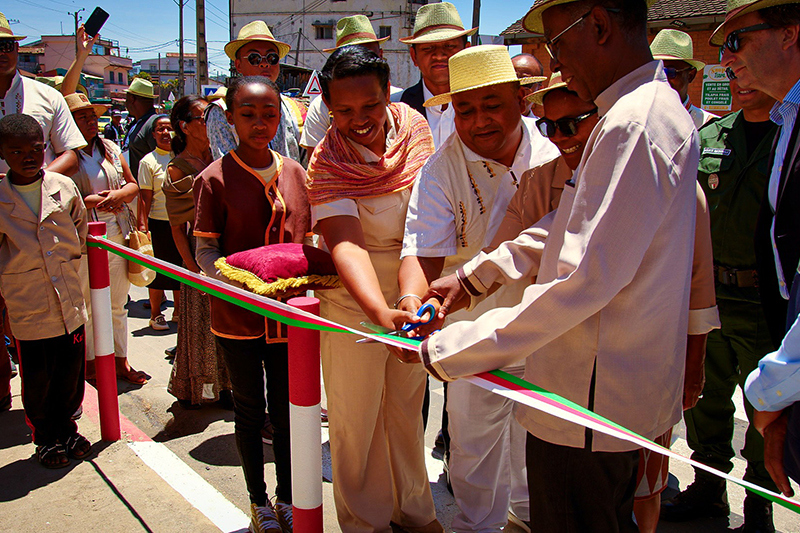
At a pilot project in the country’s capital, Antananarivo, nine in ten of Ecole Primaire Publique Manakambahiny’s almost 600 pupils walk to school, and more than half cross a road where vehicles pass at speeds of up to 69 km/h. The school has recorded eight crashes involving its pupils since 2024, and an adult was recently killed in traffic in front of the school. Implementation of the new Safe School Zone gives children – and the rest of the community – safer journeys with interventions including: A raised crossing at the school gate, with a speed bump on each side to slow traffic; 280m of sidewalk; 12 signs, including school zone and 30 km/h signs; and new road markings.
The Safe Schools Africa Roundtable focused on mechanisms to keep children safe on Madagascar’s roads and beyond. Hosted by Amend, the FIA Foundation, and the national road authority, Agence Routière de Madagascar, the event brought together 40 participants, including representatives from the European Union Delegation, the Agence Française de Développement (AFD), EIB, the TYPSA Foundation, iRAP, CODATU and Amend’s local partner, the NGO Lalana. Malagasy authorities were represented by the Commune Urbaine d’Antananarivo, the Ministries of Public Works and National Education, the Directorates General of Land Transport and Road Safety, and the National Police. FIA Foundation Director of Child and Youth Health Atsani Ariobowo opened the session by setting out the scale of child road deaths worldwide, across Africa and in Madagascar.
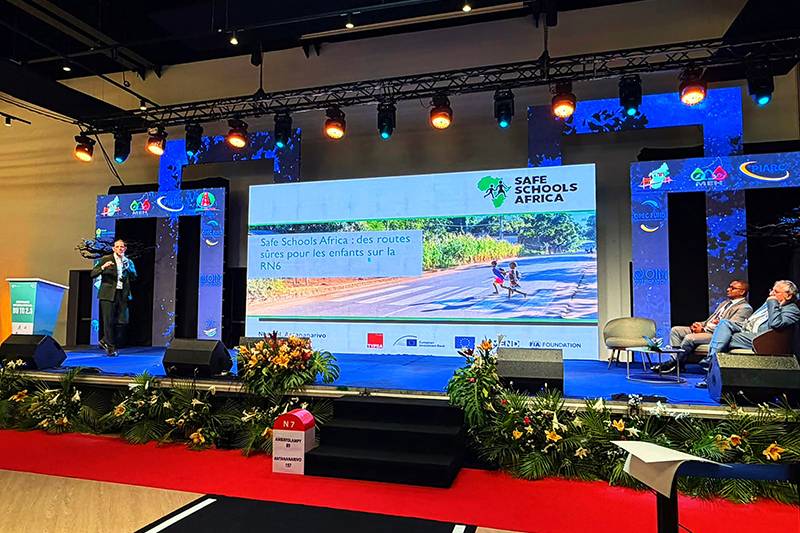
A panel moderated by Amend Executive Director Jeffrey Witte then turned to what comes next. Christophe Rakotomavo, Director General of the Agence Routière, Lydia Razafindrahona of AFD Madagascar, and road safety expert Nathalie Chiavassa, representing the TYPSA Foundation and iRAP, discussed how to bring the same approach to other road projects now underway across the country.
Atsani Ariobowo, FIA Foundation Director of Child and Youth Health, speaking at the event, added: “We are proud to work with Amend, TYPSA Foundation, EIB and the Government of Madagascar in upholding the Rights of Children to be safe in their journeys to school. We shall continue to work with our partners in ensuring the sustainability and scale-up of this work in this great and unique island-nation.”
Following the roundtable, participants joined children, parents and officials for a ribbon-cutting of the new Safe School Zone.
The series of events in Madagascar showcased how connecting government, financing institutions, engineers, and the third sector can create movement to deliver safe school journeys from individual projects to scale roads and schools across the country.


